
What Is Answering Machine Detection? From Beep Tones to AI
A complete history of answering machine detection across four technological generations — from 1970s tone thresholds to modern AI. Learn why each approach broke and how live human detection works today.
Marketing Team
VM Hunter
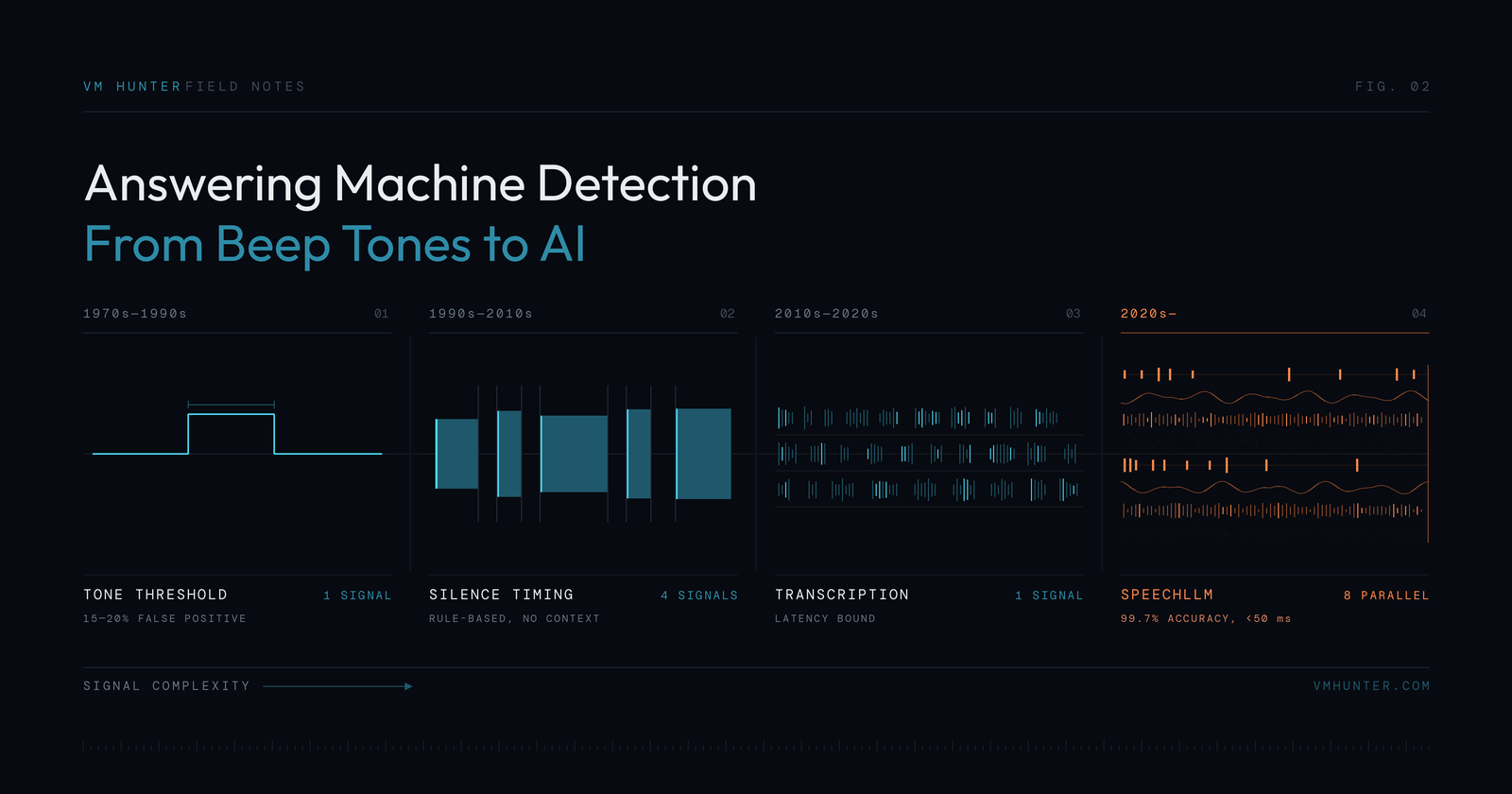
Answering machine detection is one of those technologies that seems like it should have been solved decades ago. The question it answers is trivially easy for a human: did a person pick up, or did I get voicemail? Anyone can answer that in a fraction of a second without conscious effort.
For a computer it has been genuinely hard for fifty years, and understanding why explains almost everything about how outbound calling works today — including why your dialer probably hangs up on real customers more often than you think.
This is the full history: four distinct technological generations, what each one could and could not do, why each eventually broke, and what live human detection on calls actually looks like in 2026.
What Is Answering Machine Detection?
Answering machine detection — AMD, sometimes called voicemail detection or live human detection — is the process of automatically determining whether an outbound call was answered by a live person or by a machine.
"Machine" is a broader category than most people assume. A complete system must distinguish between:
- Live human — a person who answered and is listening
- Voicemail / answering machine — a recorded greeting
- IVR or auto-attendant — an automated menu system
- Fax machine — announcing itself with a CED tone
- Carrier intercept — "the number you have dialed is no longer in service"
- Call screening — iOS Live Voicemail or Android Call Screen, where a human is present but a machine is speaking
That last category did not exist until 2023 and now represents a rapidly growing share of answered calls. It is also the category that breaks every legacy system most severely, for reasons we will come to.
Why It Exists At All
The economics are straightforward. In outbound calling, roughly 60 to 70% of answered calls reach voicemail. If agents handle that themselves, they spend six to ten seconds per voicemail listening, recognizing, and disconnecting.
For a hundred-agent operation, that is hundreds of hours per month spent listening to recordings. Worse, it destroys the arithmetic of predictive dialing — you cannot maintain a queue of ready connections if most connections are worthless.
AMD exists to filter machines before they reach a human. Get it right and agent utilization climbs from roughly 60% to over 80%. Get it wrong and you hang up on customers.
Generation One: Tone Threshold (1970s–1990s)
One signal. 15–20% false positive rate.
The first answering machines reached consumers in the 1970s, and the first detection attempts followed almost immediately. The approach was as simple as the hardware allowed.
Early answering machines were electromechanical. They played a greeting from tape and then emitted a beep to signal recording had begun. That beep was a gift to engineers: a single, relatively consistent tone at a predictable moment.
Generation one detection was a tone detector and a threshold. Listen for energy at a specific frequency. If detected, it is a machine. If not, assume a human.
Why It Worked At All
In 1980 the telephone network was remarkably uniform. Copper landlines, one codec, consistent audio characteristics, and a small number of answering machine models with similar beep frequencies. Tuning a threshold against that environment was tractable.
Why It Broke
Every assumption dissolved.
Beep frequencies diverged. As manufacturers proliferated, so did tones. A detector tuned for 1,000Hz missed a machine beeping at 1,400Hz.
Digital systems dropped the beep entirely. Carrier-hosted voicemail — introduced widely in the late 1980s — often played no terminating tone at all. The one signal generation one depended on simply vanished.
Tone detection generated false positives constantly. Background noise, music on hold, a dog barking, a door slamming — anything with energy near the target frequency triggered a detection. This is the origin of the 15 to 20% false positive rate: roughly one in five live humans got hung up on.
Generation one was a single-signal system, and single-signal systems fail whenever that signal is absent or spoofed. Both happened constantly.
Generation Two: Silence Timing (1990s–2010s)
Four signals. Rule-based, no context.
By the mid-1990s, tone detection alone was untenable. The insight behind generation two was that you do not need the beep — the rhythm of the call is informative on its own.
A human answers and says something short: "Hello?" Then they stop and wait for you to speak. An answering machine plays a long scripted greeting and then goes silent to record.
That difference is measurable without understanding a single word:
- Initial utterance duration — how long the first burst of speech lasts
- Trailing silence duration — how long the silence after it lasts
- Energy envelope — the amplitude shape over time
- Total greeting length — from answer to first silence
Four signals instead of one. Combine them with rules: if initial speech exceeds roughly two seconds, classify machine. If it is under one second followed by sustained silence, classify human.
This is the generation most call centers are still running. Asterisk's built-in AMD application, VICIdial's native detection, and most carrier-provided AMD are all generation two. If you have ever edited a config file with parameters named initial_silence, greeting, after_greeting_silence, and total_analysis_time, you have tuned a generation two system.
Why It Was Better
Genuinely more robust than tone detection. It did not depend on a signal that might not exist, and it degraded more gracefully. On clean landline calls with cooperative behaviour it reached 85 to 90% — a real improvement.
Why It Broke
Generation two carries a fatal assumption: that humans and machines behave differently in ways timing can capture. They often do not.
Professional greetings look like machines. "Good morning, Harrison Dental, this is Maria, how can I help you?" is roughly four seconds of continuous speech. Every generation two ruleset classifies that as a machine. The more professional the answerer, the more likely they get hung up on — a perverse outcome that punishes exactly the businesses most worth reaching.
Terse voicemail looks human. "It's Dave, leave it" is under a second. Classified human, routed to an agent.
Mobile networks broke the measurements. The transition from landline to mobile — from a minority of calls in 1995 to the overwhelming majority by 2015 — changed the audio itself. Mobile codecs compress aggressively. Comfort noise generation fills silence with synthesized low-level audio, which means "silence" is no longer silent and silence-duration measurement becomes unreliable. VoIP added jitter that shifts event boundaries unpredictably.
Carrier variation defeated tuning. Every carrier's audio path has a different signature. A threshold tuned on one carrier's traffic misfires on another's. There is no single correct configuration, only a compromise that is wrong somewhere.
The deeper problem is the one that defines the generation: rule-based, no context. Generation two measures the shape of audio and never processes its content. It cannot hear that someone said "leave a message after the tone." It only knows the utterance was 2.3 seconds long.
Anyone who has tuned an Asterisk AMD config knows the resulting treadmill. Reduce false positives by raising the greeting threshold, and voicemails start reaching agents. Fix that, and you start dropping humans again. You slide along a fixed trade-off curve without ever moving to a better one — because the information required to move to a better curve is not being extracted.
Generation Three: Transcription (2010s–2020s)
One signal. Latency bound.
By the mid-2010s, speech recognition had become good enough and cheap enough to apply to the problem. The idea was obvious in hindsight: instead of measuring audio shape, listen to the words.
Voicemail greetings are formulaic in every language. "You've reached." "I'm not available right now." "Please leave a message after the tone." "Press 1 to." These phrases are near-deterministic indicators of a machine.
So generation three ran the call audio through ASR, then keyword-matched the transcript. Detect voicemail phrasing, classify machine.
Why It Was Better
It finally accessed content. Suddenly the four-second professional greeting was classified correctly — the transcript contained "how can I help you," which is not voicemail phrasing. And terse voicemail was caught, because "leave it" matched the keyword set.
On the specific cases generation two failed hardest, generation three was a real improvement.
Why It Broke
Latency. This is the defining constraint, and it is why the diagram labels this generation latency bound.
Usable transcription requires audio. General-purpose ASR models are built for long-form speech and need one to three seconds of buffer before emitting a reliable transcript. Add network round-trips to a cloud ASR endpoint and total classification time lands between 1,500 and 3,500 milliseconds.
That is far too slow. By the time the answer arrives, the agent has already been connected and has already heard the greeting. The entire purpose of detection — deciding before a human is involved — has been defeated. In predictive dialing, where the whole model depends on making routing decisions in the first few hundred milliseconds, generation three was unusable.
It was still one signal. The diagram is precise here. Despite being more sophisticated than generation two's four signals, transcription-based AMD depends on a single evidence source: the transcript. When ASR degrades, the entire system degrades. And ASR degrades constantly on telephony audio — narrowband, compressed, noisy, accented, code-switched. A confused transcript means a confused classification with no fallback.
Non-verbal signals were discarded. A voicemail beep is conclusive evidence. A fax CED tone is conclusive. A carrier SIT triple is conclusive. None of these appear in a transcript. Generation three threw away the highest-precision signals available in exchange for access to content.
Keyword lists do not scale. Maintaining voicemail phrase lists across 65 languages, with regional variation and carrier-specific prompts, is an endless manual burden.
Generation Four: SpeechLLM (2020s–)
Eight parallel layers. 99.7% accuracy, under 50ms.
The insight behind generation four is that the previous three generations were each right about something and wrong to be exclusive about it.
Generation one was right that tones are conclusive evidence — and wrong that tones are the only evidence. Generation two was right that timing carries information — and wrong that timing is sufficient. Generation three was right that content matters enormously — and wrong to discard everything else to get it.
Generation four extracts all of it, in parallel, and learns how to weigh the evidence contextually:
| Layer | Signal |
|---|---|
| 01 | Beep and SIT tones |
| 02 | DTMF and fax signalling |
| 03 | Energy profile |
| 04 | Dead air structure |
| 05 | Noise fingerprint and codec |
| 06 | Pre-recorded and synthesized speech detection |
| 07 | Streaming transcription |
| 08 | Transformer classifier |
Layers 01 through 07 run concurrently on the same audio buffer. Layer 08 is a transformer trained on over 50 million labelled production calls that consumes all seven outputs and produces a calibrated probability distribution.
Why Parallelism Changes the Outcome
Every previous generation had a single point of failure. Generation one failed without a beep. Generation two failed on atypical timing. Generation three failed on degraded ASR.
Generation four fails only when most layers fail simultaneously — which is rare.
Take the case that defeats generation two completely: the four-second professional greeting. Layer 03 (energy) says machine, because the utterance is long. But Layer 07 transcribes "how can I help you," which is not voicemail phrasing. Layer 05 detects live room tone consistent with the channel. Layer 06 finds no playback characteristics. Layer 08 weighs the evidence and returns human with high confidence, correctly overriding the timing signal.
Now the case that defeats generation three: a voicemail greeting over loud background music. ASR is badly degraded and Layer 07 is unreliable. But Layer 01 detects the terminating beep. Layer 06 detects compressed dynamic range indicating playback. Layer 05 finds a room signature inconsistent with the live channel. Correct classification, despite the transcript being useless.
Layer 08 does not average these signals. It learns which evidence to trust under which conditions — down-weighting ASR when confidence is low, leaning on channel analysis when the connection is degraded.
How the Latency Problem Was Solved
Generation three was slow because transcription was on the critical path and nothing else ran until it finished.
Generation four runs the signal layers concurrently with ASR, uses an ASR model optimized specifically for short utterances rather than long-form speech, and executes inference on hardware co-located with the media path. Total budget: under 50 milliseconds. Faster than generation two's timing analysis, which had to wait for silence to elapse before deciding.
The Category Nothing Else Handles
Live human detection on calls got substantially harder in 2023, when iOS Live Voicemail and Android Call Screen arrived.
These systems answer the call and play synthesized speech asking the caller to state their purpose, while transcribing in real time for the recipient. A live human is present, holding the phone, actively deciding whether to pick up. It is arguably the highest-intent moment in the entire call.
Every earlier generation gets this catastrophically wrong. Generation two hears a long machine-like utterance and hangs up. Generation three transcribes machine-like phrasing and hangs up. Measured accuracy on screened calls is around 10%.
Generation four handles it because Layer 06 specifically detects synthesized speech — distinguishing TTS from both recorded human greetings and live human speech. The classification is neither human nor voicemail but a third state, CALLGUARD, which routes to an agent rather than disconnecting.
This matters increasingly every quarter. As screening adoption grows, a generation two dialer's real-world accuracy declines continuously even with no configuration change. The ground is moving underneath it.
The Four Generations Side by Side
| Gen 1 (1970s–90s) | Gen 2 (1990s–2010s) | Gen 3 (2010s–20s) | Gen 4 (2020s–) | |
|---|---|---|---|---|
| Method | Tone threshold | Silence timing | Transcription | 8 parallel layers |
| Signals | 1 | 4 | 1 | 8 |
| Hears content | No | No | Yes | Yes |
| Latency | Fast | Moderate | 1,500–3,500ms | Under 50ms |
| Accuracy | 60–70% | 75–85% | 85–90% | 99.7% |
| False positives | 15–20% | 8–15% | 5–10% | 0.2% |
| Long human greeting | Fails | Fails | Handles | Handles |
| Terse voicemail | Fails | Fails | Handles | Handles |
| Mobile / VoIP | Fails | Degrades | Degrades | Handles |
| Call screening | Fails | Fails (10%) | Fails | Handles (99.7%) |
| Languages | 1 | 1 | Manual per language | 65+ |
| Improves over time | No | No | No | Yes |
Which Generation Are You Running?
Most operations do not know. Here is how to tell.
You are on generation two if: your configuration includes timing parameters like initial silence, greeting length, or after-greeting silence. You use Asterisk's native AMD application, VICIdial's built-in detection, or carrier-provided AMD. Tuning feels like a trade-off where fixing one error type worsens the other.
You are on generation three if: your vendor talks about transcription or keyword matching, and classification takes over a second.
You are on generation four if: classification returns in under 100ms, you receive a cause with each result rather than a bare binary label, call screening is handled as its own category, and the model is retrained on production data.
The Diagnostic Test
The fastest way to find out where you actually stand takes an afternoon.
Sample two hundred calls from your dialer logs where AMD classified the call as a machine and disconnected. Pull the recordings. Listen to them.
Count how many were live humans.
If that number is above 5%, you are running generation two and it is costing you real money — silently, because a dropped human is indistinguishable from a voicemail in your reporting. Nothing in your dashboard measures this. It is the single most under-measured metric in outbound calling.
Where This Goes Next
Two forces are actively degrading generation two systems.
Call screening adoption is climbing. Every new iPhone and Android device ships with screening available. Generation two accuracy on those calls is around 10%, so as the share of screened calls rises, blended accuracy falls — with no change on your end.
Voicemail systems keep changing. Carriers update hosted voicemail platforms. New virtual receptionist products launch. Synthesized greetings replace recorded ones. Static rule-based systems have no mechanism to adapt; generation four systems retrain on production data and improve.
The gap widens on its own. This is the practical argument for generation four that has nothing to do with today's accuracy numbers: a static system in a changing environment gets worse, while a learning system gets better.
Conclusion
Fifty years of answering machine detection is a story about information. Generation one had one signal and lost it when digital voicemail dropped the beep. Generation two had four signals but was structurally deaf, measuring the shape of audio while never processing its meaning. Generation three could finally hear, but paid for it with latency that made it useless for predictive dialing and discarded every non-verbal signal to get there.
Generation four's contribution is refusing the trade-off. Eight independent evidence streams, extracted in parallel, fused by a model that learns which to trust under which conditions — tones and signalling and timing and silence texture and channel fingerprint and playback detection and linguistic content, all at once, inside fifty milliseconds.
The result is that live human detection on calls finally works the way a person listening would: not by timing the greeting, but by understanding it.
Ready to find out which generation you are on? Start your free trial — 5,000 calls per month, no credit card required — or read how AI answering machine detection reaches 99.7% accuracy for the technical detail behind generation four.