
AI Answering Machine Detection
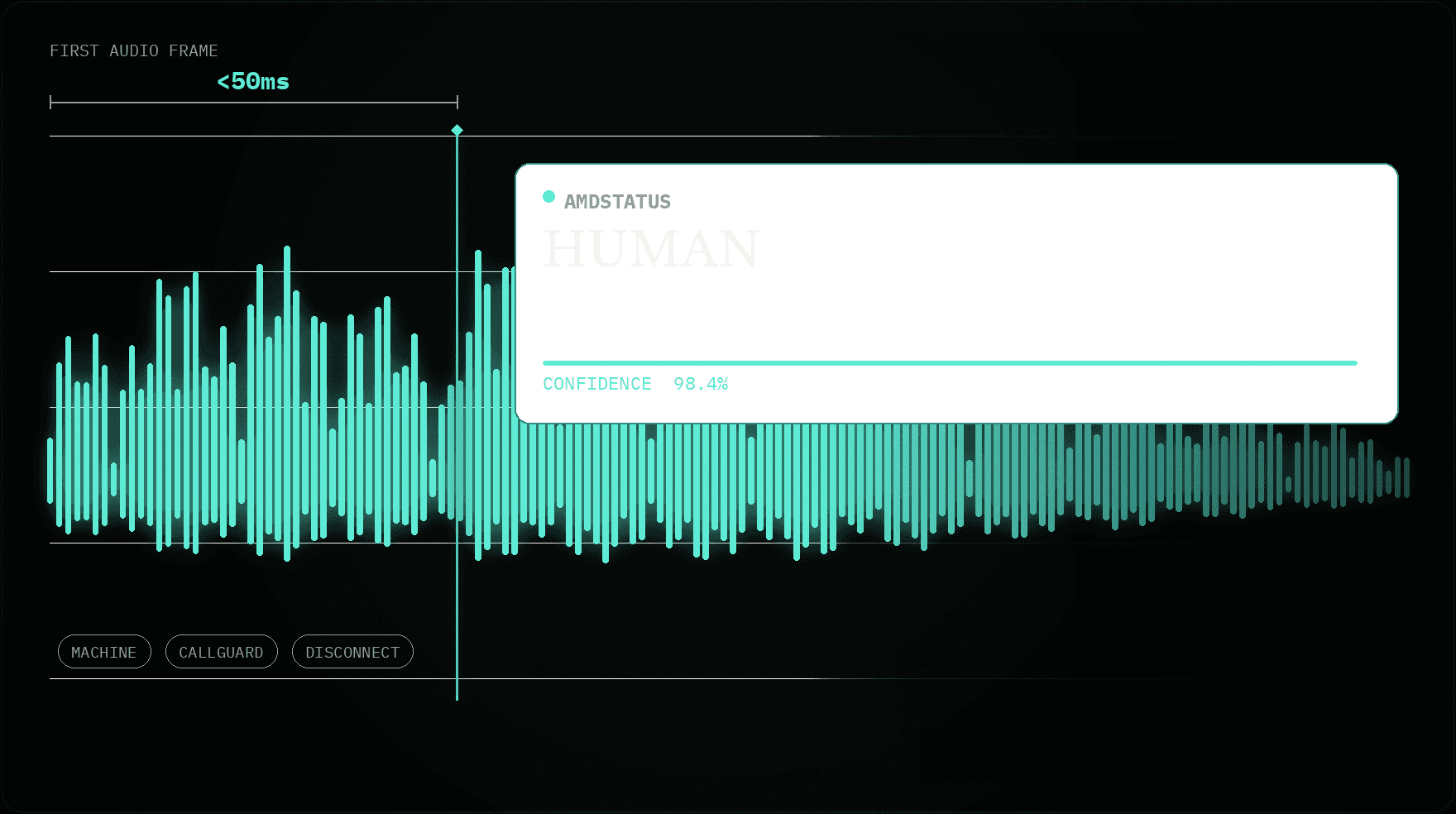
SpeechLLM detects human vs. voicemail in under 50ms, from the first audio frame — 99.7% accuracy across 50M+ analyzed calls.
No credit card required
Legacy AMD hangs up on 15-20% of real people
Rule-based answering machine detection guesses from timing and silence thresholds alone, producing a 15-20% false positive rate. Every false positive is a live prospect dropped mid-greeting and an agent left waiting on a dead line.
VM Hunter replaces that guesswork with 8 signal layers analyzed in parallel, cutting the false positive rate to 0.2% at 99.7% overall accuracy.
Legacy AMD
15-20%
False positive rate — live humans dropped
VM Hunter
0.2%
False positive rate — 99.7% accuracy overall
SpeechLLM analyzes 8 signal layers in parallel
Transcription-only systems wait for words before they can decide. SpeechLLM evaluates all 8 layers simultaneously from the first audio frame, so a classification is available before a greeting finishes.
- 01
Beep tones & SIT signals
Catches special information tones that mark disconnected or invalid numbers.
- 02
DTMF & fax tone recognition
Identifies keypad tones and fax handshakes that never belong to a live prospect.
- 03
Energy level profiling
Measures per-frame amplitude to separate speech from recorded playback levels.
- 04
Dead air tracking
Times silence windows that indicate a greeting has ended and recording has begun.
- 05
Static & noise fingerprinting
Profiles carrier noise and codec artifacts so compression never skews the result.
- 06
Pre-recorded audio detection
Flags the acoustic signature of playback audio versus a live open microphone.
- 07
Live transcription
Streams speech-to-text so the words themselves become a classification signal.
- 08
LLM phrase classification
Resolves ambiguous cases by reading greeting phrasing for intent and meaning.
The output payload
Your dialer streams 8kHz 16-bit PCM audio over WebSocket and receives one JSON result with AMDSTATUS and AMDCAUSE.
- AMDSTATUS
- HUMAN / MACHINE / CALLGUARD / FAILED
- AMDCAUSE
- Detail behind the status, such as MACHINE_BEEP, DISCONNECT or INITIALSILENCE
99.7%
Detection accuracy
<50ms
Response time
10,000+
Concurrent calls supported
99.99%
Uptime SLA
50+
Languages supported
50M+
Call recordings trained on
Agent utilization from 40% to 85%
Every voicemail an agent listens to is paid time producing zero revenue. After switching, customers move agent utilization from 40% to 85% — more than doubling the share of the day spent in live conversations without adding a single seat.
Because the gain comes from recovered talk time rather than new headcount, ROI is typically visible within the first week of deployment.
Agent utilization
+45 percentage points of recovered selling time per agent, per shift.
Live in about 30 minutes
A real-time WebSocket API with ready-made client scripts for VICIdial, Asterisk and FreeSWITCH, using standard AMD variables — no dialplan rewrites and no infrastructure replacement.
Security
- Per-customer API keys, revocable at any time
- End-to-end encryption in transit and at rest
- Call data never leaves our secure infrastructure
import WebSocket from "ws"

const socket = new WebSocket("wss://app.vmhunter.com/ws")

socket.on("open", () => {
  // 1. Config first: identifies the call, authenticates
  socket.send(JSON.stringify({ config: {
    vid: "12345",
    api_key: "YOUR_API_KEY",
    sample_rate: 8000,
    bytes_per_sample: 2,
  }}))
  // 2. Raw 8kHz 16-bit mono PCM, 20ms binary frames
  for (const chunk of pcmChunks) socket.send(chunk)
  // 3. End of audio
  socket.send(JSON.stringify({ eof: 1 }))
})

// 4. One JSON reply, then the server closes
socket.on("message", (data) => {
  const { AMDSTATUS, AMDCAUSE } = JSON.parse(data)
  // AMDSTATUS: HUMAN | MACHINE | CALLGUARD | FAILED
  // AMDCAUSE:  MACHINE_BEEP | DISCONNECT | ...
  if (["HUMAN", "CALLGUARD"].includes(AMDSTATUS)) {
    routeToAgent()
  }
})VM Hunter vs. legacy AMD
| Criterion | Legacy AMD | VM Hunter |
|---|---|---|
| Detection method | Single-signal timing rules or transcription only | 8 signal layers analyzed in parallel by SpeechLLM |
| False positive rate | 15-20% of live humans classified as machines | 0.2% false positives at 99.7% overall accuracy |
| Response time | 2-5 seconds of greeting required before deciding | Under 50ms from the first audio frame |
| Language support | English-only, degrades on regional accents | 50+ languages with accent-aware models |
| Setup time | Days of dialplan tuning and threshold tweaking | About 30 minutes with standard AMD variables |
Start free with 5,000 calls per month
The free plan includes 5,000 calls per month with full access to core detection features and no credit card required.
Paid tiers scale for professional and enterprise call centers, with savings on annual billing.
Frequently asked questions
What is AI Answering Machine Detection?
How accurate is VM Hunter's AI Answering Machine Detection?
How is AI AMD different from traditional Asterisk or VICIdial AMD?
How fast is the detection response time?
Does AI AMD work with VICIdial?
How is call audio protected?
How long does integration take?
Stop paying agents to listen to voicemail
Deploy 99.7% accurate detection in about 30 minutes and see recovered talk time in your first week.