
AI Answering Machine Detection: How SpeechLLM Hits 99.7% Accuracy
A technical breakdown of how AI answering machine detection reaches 99.7% accuracy. Inside the eight parallel signal layers, the sub-50ms latency budget, and how to verify any vendor's accuracy claim.
Marketing Team
VM Hunter
Every answering machine detection vendor publishes an accuracy number. Almost none of them publish the methodology behind it.
That gap matters more than the number itself. "95% accurate" measured on a curated set of clean landline recordings is a weaker result than "92% accurate" measured on live mobile traffic across forty carriers. Without methodology, an accuracy figure is a marketing asset rather than an engineering claim.
This article does the opposite. It explains precisely what 99.7% means for VM Hunter's AI answering machine detection, how the SpeechLLM architecture produces it, where the remaining 0.3% of errors live, and — most importantly — how you can audit the claim yourself rather than taking our word for it.
If you are evaluating vendors and want the most accurate answering machine detection for your traffic, the framework in the second half of this article will be more valuable than any single vendor's number.
What "Accuracy" Actually Means in AMD
Answering machine detection is a classification problem, and every classification problem has two distinct failure modes. Collapsing them into one "accuracy" percentage hides the information you actually need.
False positive — a live human classified as a machine. Your dialer hangs up on a real person who just said "hello." This is the expensive error. You have burned a contact, degraded your brand, and in regulated verticals you may have created a compliance event. The prospect experiences a silent hang-up, which is indistinguishable from an abandoned robocall.
False negative — a machine classified as a live human. A voicemail greeting gets routed to an agent. The agent waits, hears "please leave a message after the tone," and disconnects. You have wasted six to ten seconds of paid agent time.
These errors have wildly asymmetric costs. A false negative costs you eight seconds. A false positive costs you a customer relationship and potentially a regulatory finding. Any vendor quoting a single blended accuracy number without splitting these two rates is hiding the trade-off they chose on your behalf.
VM Hunter reports both, separately:
| Metric | VM Hunter | Typical legacy AMD |
|---|---|---|
| Overall accuracy | 99.7% | 75–85% |
| False positive rate (human dropped) | 0.2% | 8–15% |
| False negative rate (machine to agent) | 0.3% | 10–18% |
| Median classification latency | Under 50ms | 1,500–3,500ms |
| Languages covered | 65+ | 1–3 |
The reason legacy systems land in that 75–85% band is not poor engineering. It is an information ceiling, and it is worth understanding before looking at how to break through it.
Why Legacy AMD Plateaus Around 85%
Traditional answering machine detection makes its decision from a very small amount of information: how loud the audio is, and how that loudness is distributed over time.
The core heuristic has barely changed in three decades. Measure the length of the initial utterance. Measure the silence that follows it. If the greeting runs longer than roughly two seconds, or the trailing silence is shorter than some threshold, call it a machine. Otherwise call it a human.
This works acceptably in one narrow scenario: a landline, a clean connection, a human who says a short "Hello?", and an answering machine that plays a long scripted greeting. That scenario described the majority of outbound calls in 1998.
It describes almost nothing today, and the failures are systematic rather than random:
Humans do not follow the script. A receptionist answering "Good afternoon, thank you for calling Harrison Dental, this is Maria, how may I help you?" produces roughly four seconds of continuous speech. Every timing heuristic on the market classifies that as a machine. The more professional the person answering, the more likely a legacy dialer hangs up on them.
Machines do not follow the script either. A voicemail greeting of "It's Dave, leave it" is under one second. Timing logic classifies that as a human and routes it to an agent.
The network destroys the signal. Mobile codecs apply aggressive compression and comfort noise. VoIP introduces jitter that shifts event boundaries by tens of milliseconds. The same voicemail greeting produces materially different energy envelopes depending on the carrier path. A threshold tuned on one carrier's traffic misfires on another's.
Call screening did not exist when the rules were written. iOS Live Voicemail and Android Call Screen answer the call, play synthesized speech, and transcribe the caller in real time. A live human is present and about to make a decision. Legacy AMD sees synthesized audio and hangs up. Measured accuracy on screened calls is around 10% — worse than a coin flip, because the system is confidently wrong in one direction.
The pattern is consistent: legacy AMD is deaf. It measures the shape of the audio and never processes the content. Two acoustically similar recordings — one a human greeting, one a voicemail prompt — are indistinguishable to it, even though any person listening would classify them instantly and correctly.
Adding more rules cannot fix this. Every new threshold that catches a missed voicemail also catches a category of real human. Practitioners tuning legacy AMD know the feeling: you fix the false negatives and the false positives climb, and you slide along the same curve without ever moving to a better one.
Breaking 85% requires more information, not better rules.
The Eight Parallel Signal Layers
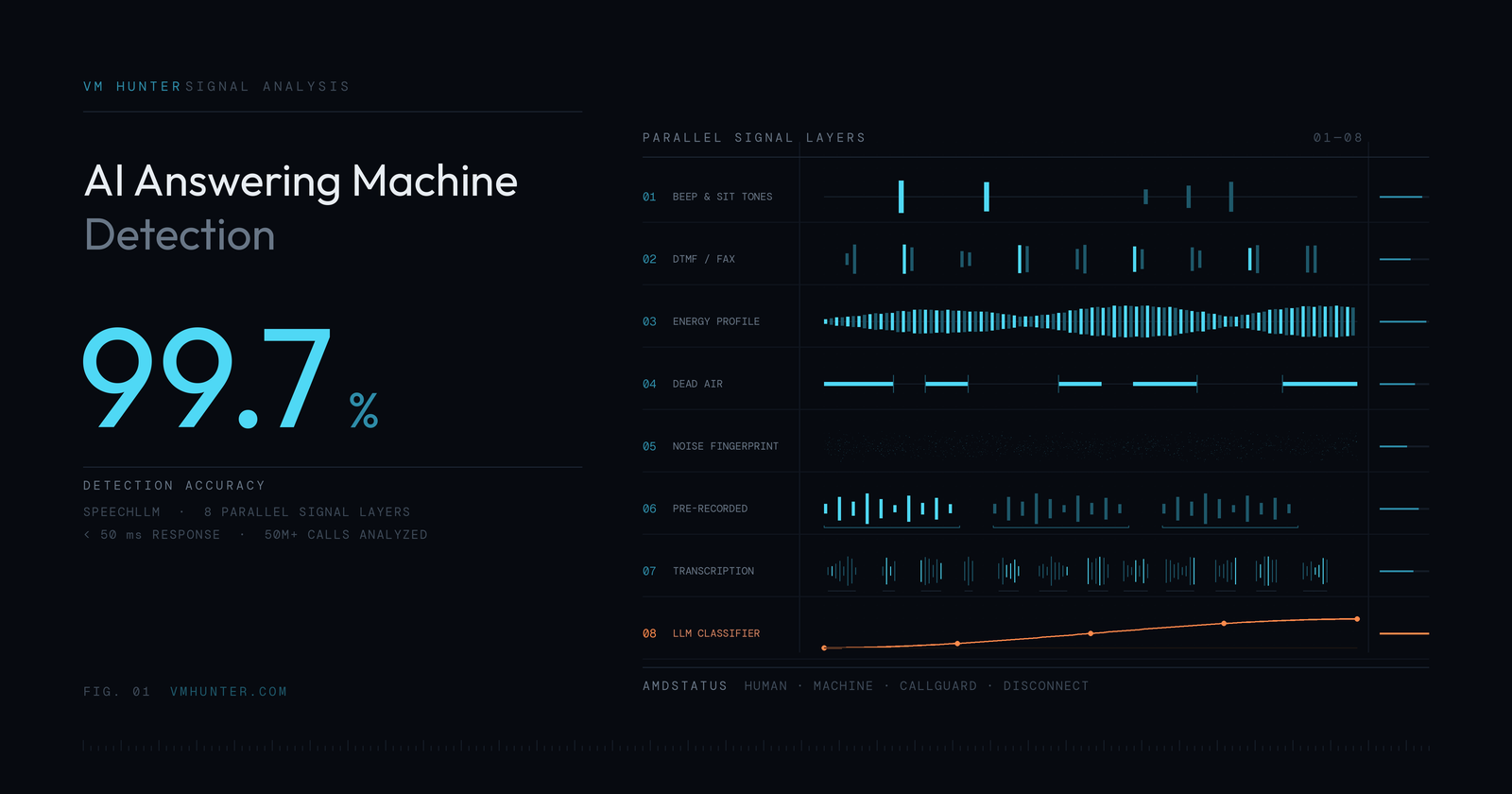
SpeechLLM extracts eight independent classes of evidence from the same audio stream, then fuses them into a single decision. The critical word is parallel. These are not sequential filters where an early mistake propagates. They run concurrently on the same buffer, and each one can be wrong without breaking the classification.
Layer 01 — Beep and SIT Tones
Answering machines and carrier systems emit standardized in-band tones. Voicemail systems play a terminating beep, typically near 1,400Hz or 2,000Hz depending on the platform. Carriers emit Special Information Tones (SITs) — precisely specified three-tone sequences that indicate a disconnected number, a reorder condition, or an unassigned circuit.
These are the highest-precision signals available. A confirmed SIT triple means the number is dead; no further analysis is required, and the record should be flagged for list hygiene rather than retried. A confirmed voicemail beep is near-conclusive for machine.
Layer 01 runs Goertzel filters tuned to the standardized frequency pairs, which detects specific tones far more cheaply than a general spectral analysis.
Layer 02 — DTMF and Fax
Fax machines announce themselves with CNG (calling tone, 1,100Hz) and CED (called terminal identification, 2,100Hz) signals. IVR systems and PBX auto-attendants emit DTMF touch-tone signalling.
Detecting these is not merely about avoiding a wasted agent connection. It is a data quality signal. A number that reliably answers with CED is a fax line, and it should be removed from a voice campaign permanently rather than retried on a schedule.
Layer 03 — Energy Profile
This is the layer legacy AMD relies on exclusively, and SpeechLLM still computes it — because it does carry real information. Amplitude envelopes, onset and offset timing, spectral flux, and speech rhythm all correlate with machine versus human.
The difference is weighting. In SpeechLLM this layer contributes roughly one eighth of the evidence rather than all of it. It is a useful prior, not a verdict. When the energy profile suggests machine but the linguistic layers suggest human, the linguistic evidence wins.
Layer 04 — Dead Air
Silence structure is genuinely informative once you stop treating it as a single threshold. Machines produce characteristically clean silence: no breathing, no room tone, no background movement, and a sharp transition from speech to nothing.
Humans produce messy silence. There is breath, there is ambient noise, there is the sound of a room. Layer 04 models the texture of silence rather than just its duration, which distinguishes "the recording ended" from "the person stopped talking and is waiting for you to speak."
Layer 05 — Noise Fingerprint
Every audio path leaves a signature. Codec artifacts differ between G.711, G.729, and Opus. Comfort noise generation produces distinctive spectral patterns. Recorded greetings carry the noise floor of the environment where they were recorded, which is often different from the noise floor of the live connection.
That last point is powerful and has no analogue in legacy AMD. A pre-recorded greeting frequently carries a different room signature than the live channel it plays over, because it was recorded in a different place at a different time. Detecting that mismatch is strong evidence for playback rather than a live speaker.
Layer 05 also identifies the codec in use, which lets downstream layers apply the correct normalization instead of assuming a generic channel.
Layer 06 — Pre-Recorded Detection
Playback has properties live speech does not. It is spectrally consistent in ways human speech never is. Its dynamic range is compressed. Crucially, it is identical on repeat — the same number called twice plays a bitwise-similar greeting, whereas a human says "hello" slightly differently every time.
Layer 06 also handles the modern hard case: synthesized speech. Call screening systems and virtual receptionists use TTS, which has detectable characteristics distinct from both recorded human speech and live human speech. Identifying synthesized audio is what lets SpeechLLM classify a screened call correctly instead of hanging up on a person who is actively deciding whether to pick up.
Layer 07 — Transcription
Streaming ASR, tuned specifically for short utterances. General-purpose speech recognition is optimized for long-form transcription and is far too slow for a sub-50ms budget. This model is optimized for the first one to two seconds of a telephone call and nothing else.
The output feeds linguistic analysis. Voicemail greetings are formulaic across every language: an identification, a status, and a callback instruction. "You've reached," "I'm not available," "after the tone," "leave a message," "press 1." These phrases are near-deterministic indicators of a machine, and no amount of energy analysis can find them.
This is the layer that closes the biggest gap in legacy AMD. A human hearing "leave a message after the beep" needs no timing analysis. Layer 07 gives the model that same information.
Layer 08 — LLM Classifier
The final layer is a transformer that consumes the outputs of layers 01 through 07 and produces a calibrated probability distribution.
It is not a voting system or a weighted average. Weights are learned and contextual — the model learns which evidence to trust under which conditions. On a noisy mobile connection where ASR confidence is low, it down-weights Layer 07 and leans on layers 05 and 06. On a clean connection with a high-confidence transcript, Layer 07 dominates.
Trained on over 50 million labelled production calls, it has learned patterns no engineer would think to encode as a rule:
- Long formal greetings with background office noise and live room tone: human, despite the duration that would trip every timing rule.
- Short greetings with a clean noise floor and compressed dynamic range: machine, despite a duration that suggests human.
- Synthesized speech asking the caller to state their purpose: call screening — route to an agent, do not disconnect.
- Speech followed by clean silence followed by a 1,400Hz tone: voicemail, with very high confidence.
The output is a full distribution, not a single label:
HUMAN:        0.976
VOICEMAIL:    0.018
CALLGUARD:    0.004
IVR:          0.001
DISCONNECT:   0.001
Why Parallelism Is the Whole Point
The eight layers create evidence redundancy, and this is the specific architectural property that produces 99.7% rather than 90%.
In a sequential pipeline, an early error is fatal. If step one misjudges the codec, every subsequent step operates on badly normalized audio and the final answer is wrong.
In a parallel architecture, layers fail independently. Consider a genuinely difficult call: a voicemail greeting on a heavily compressed mobile connection with music playing in the background.
- Layer 03 (energy) is confused — the music corrupts the amplitude envelope.
- Layer 04 (dead air) is confused — there is no clean silence to measure.
- Layer 07 (transcription) is degraded — the music interferes with ASR, confidence drops.
Legacy AMD, which is essentially Layer 03 alone, gets this wrong every time. SpeechLLM still gets it right, because:
- Layer 01 detects the terminating beep.
- Layer 05 detects a room signature inconsistent with the live channel.
- Layer 06 detects playback characteristics in the spectral envelope.
Three layers are impaired and the classification is still correct. That is what redundancy buys. The remaining 0.3% of errors are overwhelmingly cases where most layers are simultaneously impaired — extremely short greetings on extremely degraded connections, or code-switching mid-greeting between two languages.
The Sub-50ms Latency Budget
Accuracy that arrives too late is not useful. If classification takes two seconds, the agent has already heard the greeting and the value is gone.
The budget breaks down roughly as follows:
| Stage | Budget |
|---|---|
| Audio ingest and buffering | 8ms |
| Layers 01–06 (parallel signal analysis) | 12ms |
| Layer 07 (streaming ASR) | 18ms |
| Layer 08 (transformer classification) | 9ms |
| Response serialization | 3ms |
Layers 01 through 06 run concurrently, so their combined cost is the slowest layer rather than the sum. The ASR model is quantized and tuned for short utterances. Inference runs on hardware co-located with the media path to eliminate network round-trips.
The reason this matters competitively: latency and accuracy are usually a trade-off. Waiting longer means more audio and a better decision. Transcription-only approaches — the third generation of AMD — achieved decent accuracy precisely by waiting one to three seconds for a usable transcript, which made them unusable for predictive dialing. Running the signal layers in parallel with ASR is what removes the trade-off.
Verified Performance by Call Type
Blended accuracy hides everything interesting. Here is the breakdown by scenario, measured on live production traffic:
| Call type | Legacy AMD | SpeechLLM |
|---|---|---|
| Short human "Hello?" | 94% | 99.9% |
| Long formal business greeting | 65% | 99.8% |
| Standard voicemail greeting | 88% | 99.8% |
| Very short voicemail ("It's Mike") | 40% | 99.5% |
| Voicemail with background noise | 72% | 98.9% |
| iOS Live Voicemail / Android screening | 10% | 99.7% |
| Non-English voicemail | 68% | 99.2% |
| Carrier intercept / SIT | 35% | 99.8% |
| IVR / auto-attendant | 55% | 99.6% |
| Fax machine | 80% | 99.9% |
| Code-switched greeting | 20% | 97.5% |
Two rows deserve attention.
Call screening at 10% versus 99.7%. This is the largest single gap and the fastest-growing category of outbound call. As iOS and Android screening adoption rises, a legacy dialer's effective accuracy degrades every quarter even with no configuration change. The floor is moving.
Code-switched greetings at 97.5% is our weakest number, and we publish it deliberately. A greeting that begins in Spanish and switches to English mid-sentence is genuinely hard, and it is where a meaningful share of the remaining 0.3% lives.
How to Audit Any Vendor's Accuracy Claim
This is the part worth keeping regardless of which vendor you choose. If you want accurate answering machine detection, insist on the following before signing anything.
1. Demand both error rates separately. If a vendor will only give you a blended number, they are hiding which error they optimized for. Ask specifically: what is the false positive rate — how often do you hang up on a live human?
2. Test on your own traffic. Vendor benchmarks are run on vendor data. Your traffic has a specific carrier mix, geography, language distribution, and time-of-day profile. Run a pilot on a real segment of your list. Any vendor confident in their model will support a shadow-mode trial.
3. Insist on shadow mode. The cleanest test: run the new system in parallel with your existing one, logging classifications without acting on them. Compare both against ground truth. Zero production risk, real measurement.
4. Build ground truth by listening. There is no shortcut. Sample two to three hundred calls, have a person listen to each, and label it. Everything else is inference. Two to three hundred is enough to distinguish 85% from 99% with confidence.
5. Segment your results. Break the pilot down by carrier, by hour, by area code, by language. Aggregate numbers hide systematic failures. A system that is 99% overall but 60% on one major carrier is a system that will surprise you.
6. Test the hard categories on purpose. Deliberately include iOS and Android devices with screening enabled, very short voicemail greetings, non-English greetings, and disconnected numbers. This is where the differences actually appear. A clean-landline test set cannot distinguish a good system from a mediocre one.
7. Ask about model updates. A static model degrades as carriers update voicemail platforms and new screening products launch. Ask how often the model is retrained and whether production feedback informs it.
Translating Accuracy Into Dollars
Consider a call center running 50,000 dials per day at a 30% answer rate — 15,000 connected calls, of which roughly 60% are machines.
With legacy AMD at 85%:
- Roughly 900 live humans per day incorrectly hung up on
- Roughly 1,620 voicemails per day routed to agents
- At 8 seconds each, about 3.6 agent-hours wasted daily on voicemails
- 900 burned contacts daily, each representing lost pipeline
With AI answering machine detection at 99.7%:
- Roughly 12 live humans per day incorrectly hung up on
- Roughly 27 voicemails per day reaching agents
- Under 4 agent-minutes wasted daily
- 888 additional live conversations per day
At a conservative $40 fully-loaded agent hour, the recovered time alone is roughly $3.5K per month. The 888 additional daily conversations are the larger number by an order of magnitude — at a 2% close rate and a $500 average contract value, that is meaningful revenue that legacy AMD was discarding silently.
The word silently is the operative one. False positives are invisible in your reporting. A dropped human looks identical to a voicemail in your dialer logs. Most operations running legacy AMD have no idea what the number is, because nothing in their dashboard measures it.
Conclusion
99.7% is not the product of better tuning on the same approach. Legacy answering machine detection is constrained by an information ceiling: it measures the shape of audio and cannot process content, and no additional rules will move it past roughly 85%.
SpeechLLM breaks the ceiling by extracting eight independent classes of evidence in parallel — tones, signalling, energy, silence texture, channel fingerprint, playback characteristics, linguistic content, and learned contextual fusion — so that individual layers can fail without the classification failing. That redundancy is what produces sustained accuracy on real traffic rather than benchmark traffic, and running the layers concurrently is what keeps it inside 50 milliseconds.
But do not take the number on faith. Run the audit. Test on your own traffic, in shadow mode, with human-labelled ground truth, segmented by carrier, including the hard categories. That is how you find the most accurate answering machine detection for your specific operation — and it is a test we are glad to be measured on.
Start your free trial — 5,000 calls per month at no cost, no credit card required. Or read the full technical documentation for integration details.