
Voicemail Drop in VICIdial: Why It Only Works With Accurate AMD
Voicemail drop saves agents from reading the same message forty times a day, but every drop depends on the detector being right. How VICIdial's AM Message and agent VM drop work, where they go wrong, the compliance rules that apply, and a one-week measurement to see whether your drops are landing.
Marketing Team
VM Hunter
Voicemail drop is the dialer feature that plays a recorded message into a mailbox so an agent does not have to. On a floor of fifty agents it saves hours a day. It also has a dependency that most teams only discover after it has gone wrong: every drop is only as good as the answering machine detection that triggered it.
If the detector says "machine" on a live person, the dialer plays a recording at someone who just said hello. If it says "human" on a voicemail, the agent sits through the greeting and the drop never fires. And if the detector takes too long to decide, the message starts after the beep has passed and the mailbox records thirty seconds of silence followed by half your pitch.
This post covers how voicemail drop works in VICIdial, the two places it depends on AMD, the compliance rules you have to respect, and a measurement you can run in a week to find out how many of your drops are actually landing.
Two kinds of voicemail drop in VICIdial
VICIdial has two mechanisms that people call "voicemail drop", and they fail differently.
Automatic drop (AM Message). In the campaign settings, with Answering Machine Detection on, you can set an AM Message. When the detector returns MACHINE, the dialer plays that recording into the call and hangs up. No agent is involved. This is the one that scales, and the one that is entirely at the mercy of the detector, because the dialer never hears the call itself.
Agent drop (VM button). The agent is connected to the call, hears a voicemail greeting, and clicks a button that plays the recorded message and releases them. This one costs agent time, usually ten to fifteen seconds per call, but it has a human in the loop who can hear whether it is really a machine.
Most floors run both: automatic drop for the obvious machines, agent drop for whatever the detector lets through. The ratio between them is the first thing worth measuring, because it tells you how much work the detector is doing.
Where the detector decides the outcome
Three decisions happen between answer and drop, and the detector makes all of them.
Is it a machine at all? Timing-based AMD, which is what VICIdial's built-in Asterisk detector does, measures the initial silence, the length of the first burst of speech and the gaps between words. A voicemail greeting is long and continuous, so it scores as a machine. So does a receptionist who answers with the company name and a department, and so does anyone who talks for more than about a second and a half without pausing. Operators who audit this find somewhere between one in six and one in five live answers marked as machines. Every one of those gets a recorded message played at them.
When does the beep happen? A drop that starts before the beep is lost, because mailboxes only record after the tone. Some detectors return MACHINE the moment they decide and leave the timing to the dialer, which then has to wait for silence or a tone. Others hold the verdict until the beep. Either way, if the detector's beep detection is weak, the drop is mistimed and the mailbox gets silence or a truncated message.
Is it a machine the drop should go to? Not every MACHINE verdict is a mailbox. A disconnected-number recording, a business IVR, a carrier "the customer you are calling is unavailable" message and an iPhone call-screening prompt all come back as MACHINE from a timing-based detector. A drop played into any of those is wasted, and in the screening case it is worse than wasted: the iPhone owner reads a transcript of your recording and decides you are a robocaller.
A detector that returns a reason with the verdict changes this. If AMDCAUSE says MACHINE_BEEP or voicemail wording, drop. If it says DISCONNECT, retire the lead. If it says CALLGUARD_PHRASE, play a short intro and connect an agent, because there is a person behind that screen. VM Hunter returns these reasons on every call, and the VICIdial client sets them in the same AMDCAUSE variable your dialplan already reads, so routing on them is a GotoIf, not a rebuild.
A real-world example: the "drops aren't landing" complaint
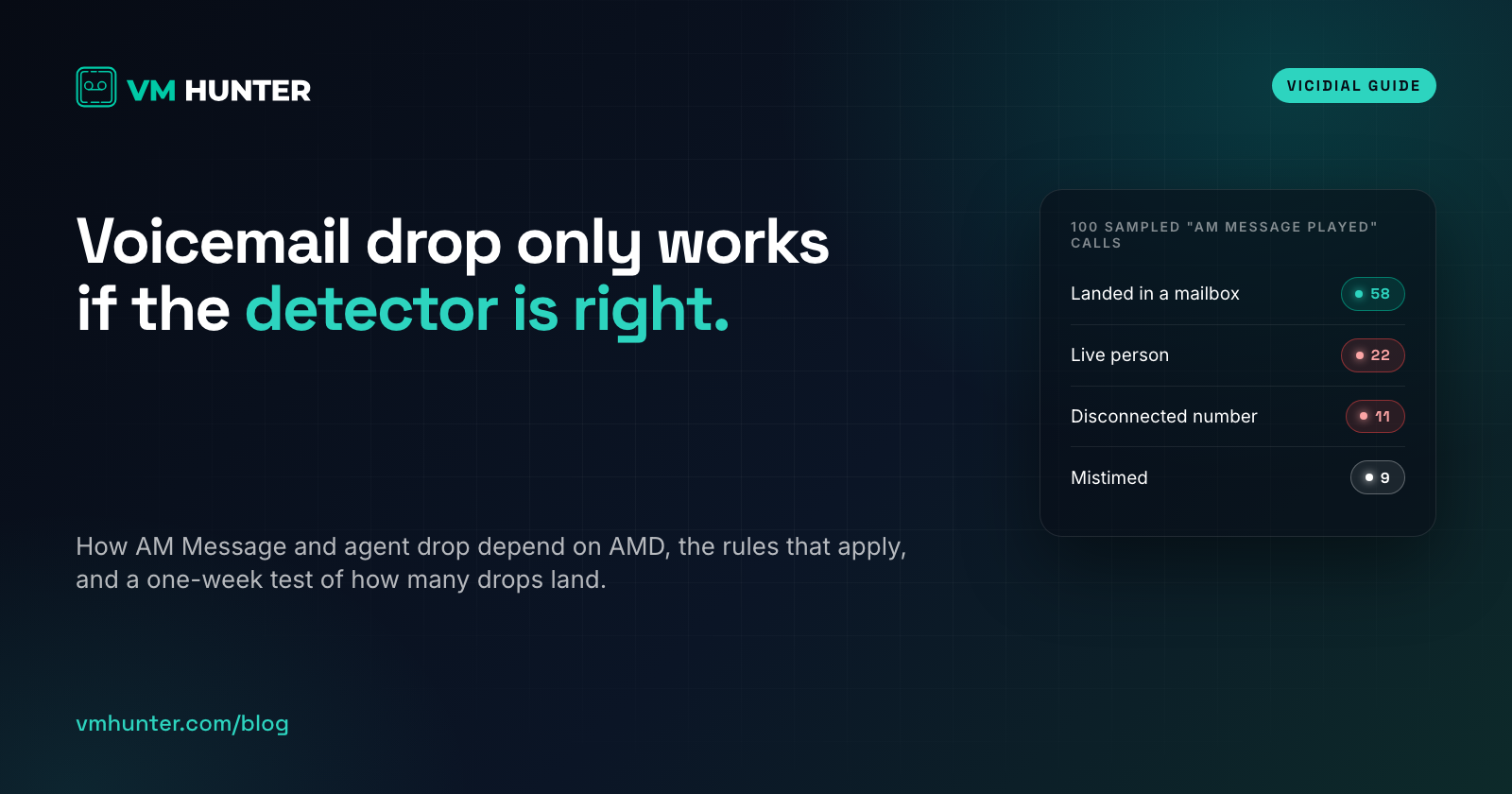
A debt-collection floor running VICIdial with the built-in detector set up automatic drops for a recycle campaign. The agents liked it immediately: their voicemail dispositions fell by two thirds. Three weeks later the compliance manager pulled a sample of a hundred "AM Message played" calls and listened to the recordings.
Twenty-two were live people. Most had answered with a longer greeting, a company name or "Hello, who's this?" and got a recorded message in reply. Several had complained. Eleven were disconnected-number messages where the drop had played into nothing. Nine were mistimed: the message had started during the greeting and the mailbox held only the last few words. Fifty-eight had landed properly.
Fifty-eight percent is a typical number for timing-based detection on a consumer list. The feature was not broken. The detector feeding it was wrong on four calls in ten, and the automatic drop had quietly turned every one of those errors into a customer-facing event.
The compliance rules you cannot skip
Voicemail drop sits on top of rules that were written for pre-recorded messages, and those rules are strict.
In the United States, the TCPA treats a pre-recorded voice message as regulated whether or not a person answers. Consent requirements depend on the number type and the purpose of the call, and the penalties are per call. The FTC's Telemarketing Sales Rule adds the abandonment rules: a call counts as abandoned if a live person answers and is not connected to an agent within two seconds of their completed greeting, and if your detector drops a recorded message on a live person, you have just abandoned a call and delivered a pre-recorded message to someone who did not consent to one.
"Ringless voicemail", where the message is inserted into the mailbox without a call being placed, is a separate product with its own regulatory history, and the FCC has treated it as a call. Do not assume that ringless delivery is exempt from any of this.
None of this is legal advice. The practical point is simpler: the detector's false-positive rate is also your compliance exposure, because every live person misclassified as a machine receives a pre-recorded message they did not agree to. The better the detection, the smaller that number.
Settings that matter in VICIdial
If you are setting this up or tuning it, these are the campaign-level controls that interact with voicemail drop. Names vary slightly between VICIdial and ViciBox versions, so check your own admin.
- Answering Machine Detection must be on for automatic drops to fire. With VM Hunter installed, this is handled by the client in the AMD extension, and the campaign setting stays on.
- AM Message is the recording played on a MACHINE verdict. Keep it under twenty seconds. Mailboxes cut long messages, and a long message makes the mistimed-drop problem worse.
- AMD Send to VMX and the related routing options control what happens after a machine verdict. This is where a reason code earns its keep: route DISCONNECT to a retirement status rather than a drop.
- Drop Call Seconds and the adaptive dial settings decide how aggressively the dialer places calls. A detector that hands fewer false humans to agents lets you run a higher dial level without pushing the abandon rate up, which is covered in its own post on dial level and drop rate.
- Agent VM drop is enabled per campaign and gives agents the button. Train agents to use it rather than reading the message, and track how often they need it. A rising agent-drop count means the automatic detection is missing more machines.
How to measure whether your drops are landing
You do not need a tool for this, only a week and a spreadsheet.
- Pull every call dispositioned as AM Message played for one campaign over seven days.
- Sample a hundred at random and listen to the recordings. Mark each as landed (message in a real mailbox after the beep), live person, non-mailbox machine (disconnect, IVR, screening) or mistimed.
- Count the agent drops over the same period. These are machines the detector missed.
- Work out the cost. Live-person drops are complaints and compliance exposure. Non-mailbox drops are wasted dial time and leads that should have been retired. Agent drops are agent seconds, roughly twelve per call.
If the landed share is above ninety percent you are in good shape. If it is in the sixties, the detector is the problem and no amount of tuning the message will fix it. Running a speech-based detector alongside the built-in one for the same week, on the same campaign, gives you the comparison in your own numbers rather than anyone's marketing.
What changes with a speech-based detector
A detector that transcribes the first two seconds and decides from the words makes three specific differences to voicemail drop.
It recognises a voicemail greeting by what it says, so "Hi, you've reached Sarah" is a machine and "Hello, Sarah speaking" is a person, even though they sound identical to a timer. It labels the non-mailbox machines, so disconnects and screening prompts stop receiving drops. And it detects the beep as a distinct event, so the drop can be timed to it.
The agents notice the first one, because the live-person complaints stop. The compliance team notices the second. The finance team notices the third, because the recycle campaign stops burning dial minutes playing messages into dead numbers.
FAQ
Does voicemail drop work without AMD in VICIdial? Only the agent drop does. Automatic drops need a MACHINE verdict to trigger, so with detection off the agent has to hear every greeting and press the button.
How long should the drop message be? Fifteen to twenty seconds. Say who you are, why you called and a number to call back. Anything longer gets truncated by many mailboxes and makes a mistimed drop more obvious.
Why do my drops start during the greeting? The detector returned MACHINE early and the dialer did not wait for the beep. Check whether your detector reports the beep separately, and whether the dialer is configured to wait for silence before playing the message.
Is ringless voicemail safer than a dialer drop? Not in the US. The FCC has treated ringless voicemail as a call subject to the TCPA. Treat both the same way for consent.
Can I drop a message on iPhone call screening? You should not. The screening prompt is answered by a person reading a transcript. Play a one-line intro naming your company and connect an agent instead. A detector that labels screening as its own category makes this a dialplan branch.
What is a good automatic drop rate? There is no universal number. What matters is the share of drops that land in a real mailbox after the beep. Measure that with the sampling method above and aim for over ninety percent.
Voicemail drop is one of the highest-return features in VICIdial, and one of the easiest to misjudge, because the dialer reports every drop as a success. The detector decides which of them actually were. If you want to see what your own drops look like with a speech-based verdict in front of them, the free plan covers five thousand calls a month and the VICIdial client installs in under an hour.