
VICIdial vs Five9 AMD: Which Actually Reduces False Positives?
A head-to-head comparison of VICIdial and Five9 answering machine detection, and why neither publishes the number that matters. How to measure your own false positive rate instead of trusting a datasheet.
Marketing Team
VM Hunter
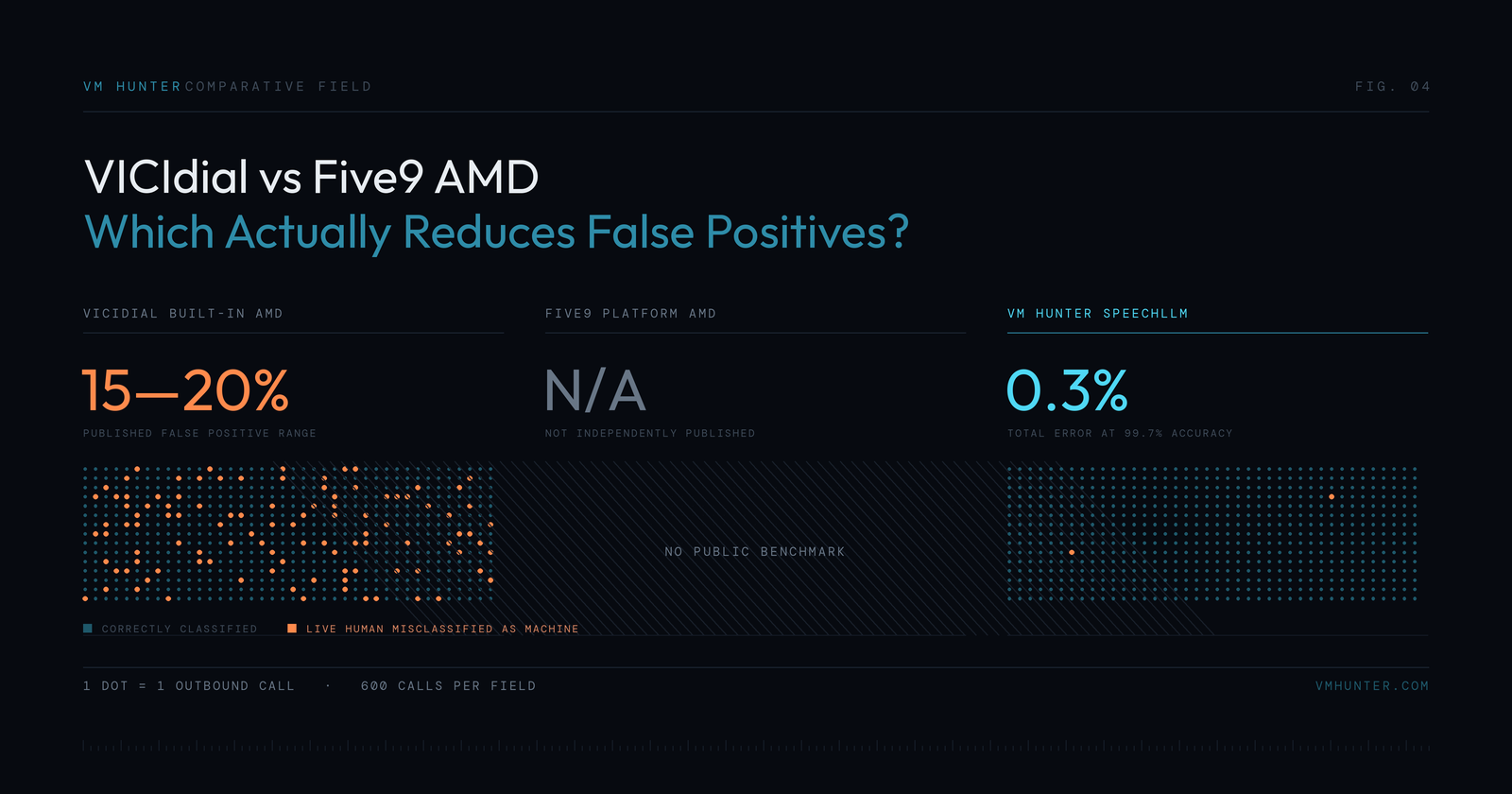
"Which dialer has better answering machine detection, VICIdial or Five9?" is one of the most common questions in outbound operations, and it has an unsatisfying answer: nobody can tell you, including the vendors.
That is not evasion. It is a statement about the state of published evidence. VICIdial's detection is open-source, well-documented, and its failure modes are measurable by anyone who reads the code — which is why a 15–20% false positive range is commonly cited. Five9 does not publish an independently verifiable false positive rate at all. Neither does Genesys, NICE, or most other enterprise platforms.
So a genuine comparison cannot be "VICIdial scores X, Five9 scores Y." It has to be a comparison of architectures, failure modes, and what each platform lets you measure. That is what this article does — and it ends with the measurement protocol you should run on your own traffic, because that is the only number that describes your operation.
Why False Positives Are the Metric That Matters
Answering machine detection has exactly two failure modes, and treating them as equivalent is the single most common analytical error in this space.
A false negative is a machine classified as a human. A voicemail greeting reaches an agent. The agent listens for a moment, hears "please leave a message," and disconnects. Cost: roughly six to ten seconds of paid agent time.
A false positive is a live human classified as a machine. Your dialer hangs up on a real person who just said "hello." Cost: a burned contact, a damaged brand impression, and — in collections, healthcare, or financial services — potentially a regulatory finding, because from the recipient's perspective a silent hang-up is indistinguishable from an abandoned robocall.
These costs differ by orders of magnitude. Eight seconds of agent time is worth pennies. A lost contact in a B2B pipeline can be worth hundreds of dollars in sourcing cost alone, before considering the deal that never happened.
This asymmetry has a consequence that most vendor datasheets quietly exploit: a single blended "accuracy" percentage hides which error the vendor optimized for. A detector tuned aggressively toward catching every voicemail will post a high overall accuracy while generating a false positive rate that quietly destroys pipeline. A detector tuned conservatively will let more voicemails through and look worse on the same blended metric while being dramatically better for your business.
Any comparison that does not split the two rates is not a comparison. It is marketing.
There is a second, worse problem. False positives are structurally invisible in standard dialer reporting. Consider what your logs contain after a call your detector labelled as a machine. If it truly was a voicemail, the row says "machine." If it was actually a live human you hung up on — the row still says "machine." The two outcomes are identical in the data. Nothing in a stock VICIdial report or a standard Five9 dashboard distinguishes them.
This is why most operations have never measured their false positive rate. Not because they are careless, but because the number does not appear anywhere unless you deliberately construct an experiment to find it.
VICIdial's AMD: Transparent and Measurably Limited
VICIdial inherits its detection from Asterisk's res_amd module, originally written in 2006 and substantially unchanged since.
The method is purely durational. It measures how long sound occurs and how long silence occurs in the opening seconds of a connected call, then applies thresholds:
| Parameter | Default | Meaning |
|---|---|---|
initial_silence | 2500 ms | Silence before speech begins |
greeting | 1500 ms | Longest allowable "human" greeting |
after_greeting_silence | 800 ms | Pause following the greeting |
total_analysis_time | 5000 ms | Decision deadline |
maximum_number_of_words | 3 | Above this, guess machine |
silence_threshold | 256 | Energy level counted as silence |
The underlying assumption is that humans answer briefly and then wait, while machines talk longer and then beep. Note what is absent: the detector has no access to what was said. It cannot distinguish "Hello?" from "You've reached Dana."
The failure modes follow directly and are entirely predictable:
- The talkative human. "Good morning, Dana speaking, how can I help you?" exceeds both the greeting duration and the word count. Classified as a machine. Hung up on.
- The terse voicemail. "Leave a message." Three words, brief, followed by a beep the detector may or may not catch. Classified as human. Routed to an agent.
- Mobile network reality. Roughly 70% of outbound contact volume now terminates on mobile networks, where variable jitter, codec transitions, and comfort-noise generation systematically corrupt the silence measurements the entire model rests on.
- Carrier screening products. Automated screening announcements match neither template and produce essentially arbitrary output.
- Non-English and bilingual greetings. Word-count heuristics calibrated on English cadence do not transfer.
The commonly cited false positive range for this approach is 15–20%. Roughly one in six live humans gets hung up on.
To VICIdial's genuine credit: you can verify every bit of this. The source is public, the parameters are documented, and you can instrument the dialplan to log exactly why each decision fired via AMDCAUSE. The limitation is honest and inspectable. That is worth more than it might sound, because the alternative is a black box.
Five9's AMD: Better Engineered, Unpublished Numbers
Five9 is a mature enterprise cloud contact center platform, and it would be wrong to imply its detection is merely res_amd in a nicer wrapper. It is a proprietary implementation with real engineering investment behind it, and Five9 has meaningful advantages VICIdial does not:
- Carrier-level integration. Operating its own telephony infrastructure gives Five9 access to signalling information — SIP headers, carrier-provided call progress indicators, network-level tones — that a self-hosted Asterisk box behind a SIP trunk may never see.
- Aggregate traffic. Enormous call volume across a large customer base is exactly the raw material needed to calibrate a detector.
- Managed tuning. You are not editing
amd.confyourself, which removes a substantial category of misconfiguration.
What Five9 does not provide is a published, independently verifiable false positive rate. Marketing materials reference accuracy in general terms. There is no public methodology document stating what traffic mix was tested, how ground truth was established, how the two error types split, or how performance varies by carrier and by greeting type.
This is not unique to Five9 — it is the industry norm across enterprise CCaaS platforms. But it has a practical consequence when you are evaluating: you cannot compare Five9's detection to anything on paper. You can only compare it to something on your own traffic.
And there is a subtler issue. On a proprietary platform, detection is a component of a bundle rather than an independently selectable capability. If it underperforms on your specific traffic mix, your remediation options are limited to whatever configuration surface the vendor exposes. You cannot swap the detector.
The Comparison Nobody Publishes
Setting the marketing aside, here is what can honestly be said:
| Dimension | VICIdial built-in | Five9 platform AMD | AI detection (SpeechLLM) |
|---|---|---|---|
| Method | Durational thresholds | Proprietary, undisclosed | Parallel multi-signal + content |
| Processes greeting content | No | Not disclosed | Yes |
| Published false positive rate | 15–20% | Not published | 0.2% |
| Published methodology | Source is public | No | Yes |
| Independently auditable | Yes, fully | No | Yes, via shadow mode |
| Distinguishes IVR from voicemail | No | Partially | Yes |
| Detects carrier screening | No | Partially | Yes |
| Tunable by you | Fully | Limited | Yes, by campaign |
| Swappable | Yes | No | N/A |
The row that deserves the most attention is not any accuracy figure — it is "independently auditable." VICIdial's detection is limited but you can measure it precisely. Five9's may well be better, but you cannot know by how much without running the experiment yourself.
The third column exists because the framing of the original question is incomplete. "VICIdial or Five9" treats detection as something you inherit from your dialer choice. On an open platform it is not: detection is a replaceable component. You can keep VICIdial's dialing, pacing, agent interface, and reporting while replacing only the classifier — which means the real comparison is between inherited detection and chosen detection.
Why Content Is the Ceiling
The reason durational approaches plateau around 80–85% is an information ceiling, not a tuning problem. No adjustment to amd.conf will fix it, because the distinguishing evidence is not present in the measurements being taken.
Consider two audio clips, each 1.8 seconds of speech followed by 700 ms of silence:
- Clip A: "Good morning, Dana speaking."
- Clip B: "You've reached Dana Whitfield."
Durationally these are close to identical. Any detector measuring only speech and silence intervals must classify them the same way, and one of those classifications will be wrong. The information that separates them is entirely lexical — the phrase "you've reached" is one of the strongest voicemail indicators in English, and a detector that cannot process content cannot use it.
Modern AI detection resolves this by evaluating several independent classes of evidence concurrently rather than as a threshold cascade:
- Tone detection for beeps and SIT tones
- Signalling and call-progress indicators
- Energy envelope characteristics
- Silence texture, which distinguishes live-room noise floor from digital silence
- Channel fingerprinting for codec and network path
- Playback artifacts that indicate recorded rather than live audio
- Linguistic content of the greeting
- Learned fusion across all of the above
Because these run in parallel, any individual signal can be inconclusive without the classification failing. A noisy mobile connection that destroys the silence measurement still yields a confident answer from content and playback artifacts. That redundancy is what produces a 0.2% false positive rate rather than 15%, and it is why the improvement holds on live traffic rather than only on curated benchmarks.
Measure Your Own Rate
Whatever platform you run, this protocol produces the number that actually describes your operation. It requires no vendor cooperation.
1. Establish a baseline. Pull your current classification distribution:
SELECT amd_status, COUNT(*) AS calls
FROM vicidial_log
WHERE call_date >= NOW() - INTERVAL 7 DAY
GROUP BY amd_status;
On Five9, export the equivalent call-disposition report. This is your before picture. It does not contain your false positive rate — that is the point.
2. Run shadow mode. Route every call to an agent regardless of what the detector says, while logging what it would have decided. On VICIdial this is one dialplan line:
exten => _91NXXNXXXXXX,n,Set(CDR(userfield)=${AMDSTATUS}:${AMDCAUSE})
3. Establish human ground truth. Have agents disposition what they actually reached — live person, voicemail, IVR, disconnected. Agent disposition is your label; the detector's verdict is the prediction.
4. Compute both rates separately. Cross-tabulate:
| Agent reached human | Agent reached machine | |
|---|---|---|
| Detector said HUMAN | True negative | False negative |
| Detector said MACHINE | False positive | True positive |
The bottom-left cell is the number nobody has. Divide it by the total humans reached and you have your false positive rate.
5. Segment the results. Aggregate numbers hide the problems. Break the same table down by:
- Carrier and mobile vs. landline — mobile is where durational detection degrades most
- Time of day — answer behavior differs materially morning vs. evening
- Greeting language — if any share of your list is non-English, check it separately
- Campaign type — B2B office greetings behave differently than B2C mobile
6. Include the hard cases deliberately. Any detector looks good on a clean landline voicemail with a loud beep. Ensure your sample includes talkative human greetings, terse voicemail, IVR trees, carrier screening announcements, and calls answered in noisy environments. A vendor test that excludes these is not a test.
Run at least 2,000 calls, and preferably a full week to capture day-of-week variation. Sampling a single afternoon will overfit to that afternoon.
What the Answer Costs
Model an operation running 50,000 dials per day at a 30% answer rate — 15,000 connected calls, roughly 40% of which reach live humans, so about 6,000 human contacts daily.
At a 15% false positive rate: roughly 900 live humans hung up on every day. Not annually. Daily. Over a 250-day working year that is 225,000 reachable people who were contacted, answered, and were disconnected without ever hearing a word.
At a 0.2% false positive rate: roughly 12 per day.
The recovered agent time from fewer misrouted voicemails is real but comparatively minor — a few thousand dollars monthly at typical loaded agent costs. The 888 additional daily conversations are the material number. At a 2% close rate and a $500 average contract value, that is roughly $8,800 per day in pipeline that the detector was discarding silently.
The word silently is the whole problem. None of this appears in a dashboard. There is no alert, no report, no anomaly. The calls are logged as machines and the operation continues, structurally unable to see its largest source of lost contacts.
So Which One?
The honest answer to the original question:
VICIdial's built-in AMD has a known, measurable, and poor false positive rate. 15–20% is a real cost, but it is a visible cost — you can audit it, instrument it, and prove it. And because VICIdial is open, you can replace the detector without replacing the platform.
Five9's AMD is probably better than res_amd and its actual rate is unknown to you. Better carrier integration and a proprietary model are genuine advantages, but without published methodology you are accepting a claim rather than evaluating evidence — and you cannot swap the component if it underperforms on your traffic.
Neither comparison is the one that matters, because detection quality is not something you have to inherit from your dialer. The largest available improvement for most operations is not switching platforms — it is replacing the classifier while keeping the platform.
Whatever you conclude, run the measurement. The false positive rate of your current setup is the single most valuable unknown number in your operation, it takes about a week of shadow-mode logging to obtain, and no vendor can supply it for you.
Start your free trial — 5,000 calls per month at no cost, no credit card required. Or read the VICIdial integration guide to see what replacing the detector involves.