
VICIdial Dial Level and Drop Rate: Staying Under the 3% Abandon Limit
Every outbound floor wants a higher dial level and every regulator wants a lower drop rate. The two are linked by one number: how many of the calls the dialer thinks are people actually are. How VICIdial's dial level, adaptive methods and drop settings work, what the 3% rule really says, and why answering machine detection is the lever most admins never pull.
Marketing Team
VM Hunter
Dial level is the setting every VICIdial admin wants to push up and every compliance manager wants to pull down. Push it up and agents spend more time talking. Push it too far and calls get answered with no agent free, the dialer drops them, and the abandon rate climbs toward the limit regulators enforce.
What most tuning guides miss is that the ceiling on dial level is not really a dialer setting. It is set by how often the calls the dialer hands to agents turn out to be people. Fix that number and the dial level has room to rise without the drop rate moving. This post walks through how the settings interact, what the rules actually say, and how answering machine detection decides where the ceiling sits.
What dial level means
In a predictive or ratio campaign, dial level is the number of lines the dialer places per available agent. A dial level of 1.0 means one call per free agent: nothing is dialled that cannot be answered. A dial level of 3.0 means three calls per free agent, on the assumption that two of the three will not reach a person.
The assumption is the whole game. On a consumer list, perhaps a third of calls are answered at all. Of the answered calls, some are voicemails, some are disconnected-number recordings, some are IVRs and some, increasingly, are call-screening prompts. Only the remainder are live people who need an agent in the next two seconds. The dialer's job is to place enough calls that live people arrive at roughly the rate agents free up, and no faster.
If the dialer overestimates how many calls will fail, it dials too few and agents wait. If it underestimates, it dials too many, live people answer with nobody free, and the call is dropped.
The 3% rule and the 2-second rule
In the United States, the FTC's Telemarketing Sales Rule sets the standard most floors tune to. A call is abandoned if a live person answers and is not connected to a sales representative within two seconds of that person's completed greeting. A seller must abandon no more than three percent of answered calls, measured per campaign over a thirty-day period. If a call is abandoned, a recorded message identifying the caller must play within two seconds of the greeting, and the call must ring for at least fifteen seconds or four rings before being treated as unanswered.
The UK's Ofcom rules use the same three percent figure, measured per campaign per twenty-four-hour period, with their own requirements for the information message and a limit on how often one number may be abandoned. Canada, Australia and the EU member states have their own versions. Whatever your jurisdiction, the shape is the same: a small percentage of live answers may be dropped, and everything hinges on what counts as a live answer.
That last part is the link to detection. The denominator is answered calls that reached a person. The numerator is those people who were not connected in time. Both depend on the dialer knowing which answered calls were people.
The settings in VICIdial that control it
VICIdial exposes the mechanics in the campaign settings. The names are from current versions; older ones differ slightly.
Dial Method chooses the strategy. MANUAL and RATIO are fixed. ADAPT_HARD_LIMIT, ADAPT_TAPERED and ADAPT_AVERAGE adjust the dial level automatically from the campaign's recent drop rate and answer statistics, within a maximum you set.
Auto Dial Level is the starting multiplier, and under the adaptive methods the ceiling.
Drop Call Seconds is how long an answered call waits for an agent before the dialer gives up and drops it. Set it to two or lower if you intend to stay inside the two-second rule; a longer value does not avoid the abandon, it just makes the person wait longer before being abandoned.
Adaptive Dropped Percent (the target drop rate under ADAPT methods) tells the dialer what abandon rate to steer toward. Setting it at the legal limit leaves no margin. Most floors run it at one or one and a half percent.
Adaptive Maximum Level and Adaptive Intensity bound how far and how fast the adaptive method moves the dial level.
Drop Action and Safe Harbor Audio decide what the dropped caller hears. If you rely on the safe-harbor message, it has to play within the two-second window.
Answering Machine Detection and the AMD routing options decide which answered calls are counted as people at all, which is the part the rest of this post is about.
Why detection sets the ceiling
Consider a campaign where forty percent of answered calls are live people and the other sixty percent are voicemail, dead numbers and screening prompts. With a detector that correctly identifies the sixty percent, the dialer connects only the forty percent to agents, and the adaptive method can hold the dial level high because live-person arrivals are predictable.
Now consider the same campaign with a timing-based detector that marks one in five live people as machines and lets one in four machines through as human. Two things happen.
The false humans reach agents. Each one takes an agent for ten to fifteen seconds of greeting before being dispositioned. That is agent capacity the dialer thought was available. Live people arrive to find agents busy with voicemails, and the drop rate rises.
The false machines are dropped from the agent path. A live person who said hello and was marked as a machine either gets a voicemail drop played at them or hears the dialer hang up. That is an abandoned call by any reasonable reading of the rule, and it does not appear in the dialer's own abandon statistics because the dialer believes it was a machine.
The adaptive method sees the rising drop rate and pulls the dial level down. Agents start waiting between calls. The admin raises the maximum, the drop rate climbs, and the cycle repeats. The ceiling on dial level is being set by detection errors, not by the list or the agents.
An illustration: same list, two detectors
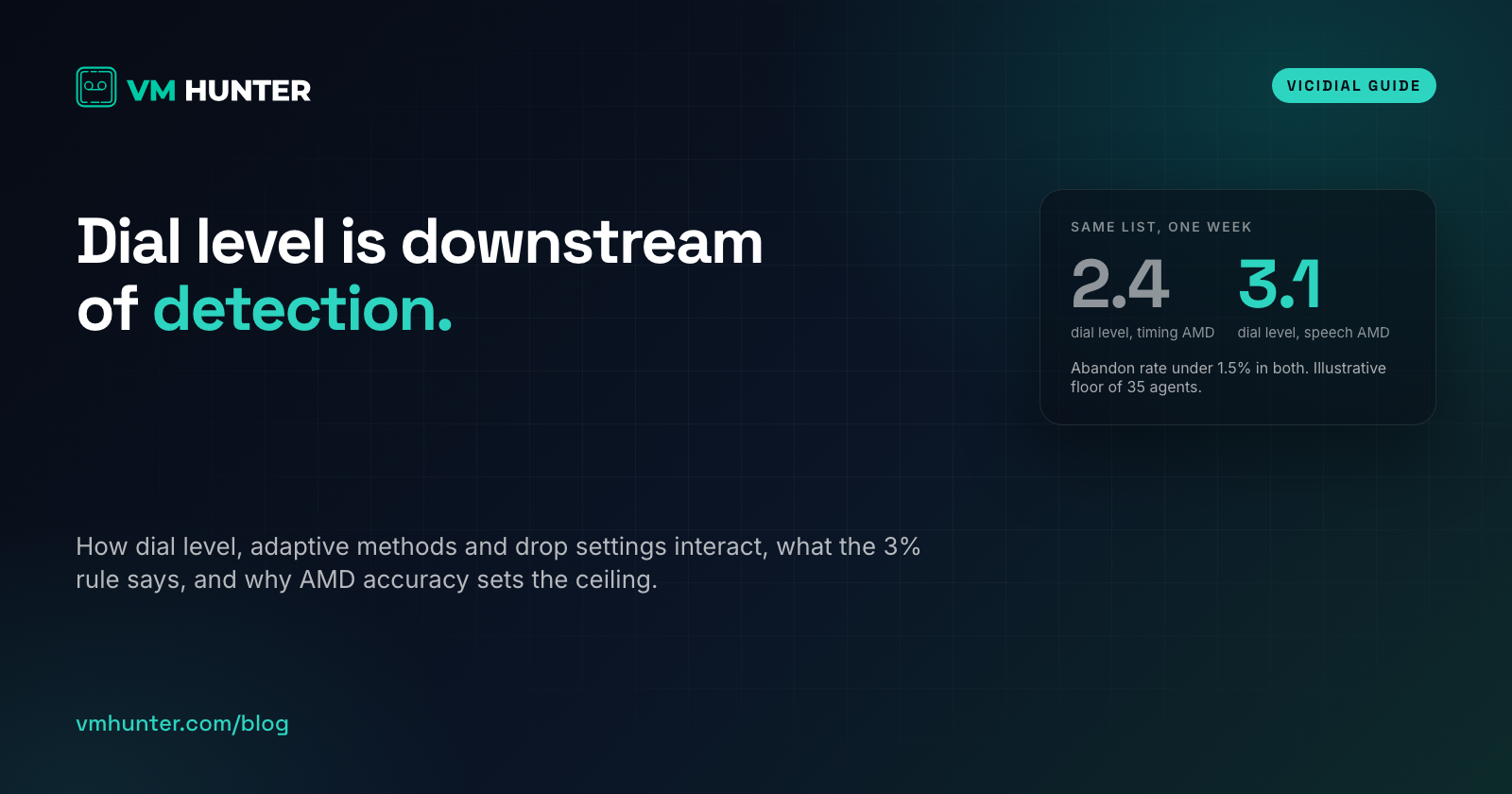
This is an illustrative scenario, not a VM Hunter customer. A lead-generation floor of thirty-five agents ran a consumer list on VICIdial with the built-in detector. They had settled on a maximum dial level of 2.4 after months of trial and error. Any higher and the thirty-day abandon rate crept past two and a half percent, which their compliance team treated as the red line.
They ran a one-week test with a speech-based detector on the same campaign. The agent-reported voicemails fell from several per hour to a handful per shift. More importantly, the dialer's view of answered calls changed: it now knew which answers were people and which were not, and the adaptive method found that live-person arrivals were far steadier than it had assumed.
With the drop target unchanged, the adaptive level settled around 3.1 by the end of the week. Talk time per agent-hour rose by roughly a fifth, the measured abandon rate stayed under one and a half percent, and the hidden abandons, live people dropped as machines, became visible in the call logs because the detector recorded a reason with each verdict. The floor had not changed a single dial setting. The detector had changed what the dial settings were working with.
The hidden abandon problem
This deserves its own section because it catches people out in audits.
VICIdial's drop statistics count calls the dialer knew were live and failed to connect. They do not count calls the detector marked as machines that were actually people. If your detector's false-machine rate is fifteen percent, then fifteen percent of your live answers are being disconnected or played a recording, and none of it shows up in the abandon report.
A regulator or a plaintiff's lawyer who pulls recordings does not use the dialer's classification. They listen. If the recording has a person saying hello followed by a hang-up or a pre-recorded message, it is an abandoned call, whatever the disposition says.
The only fix is a detector that is right more often, and a way to audit it. A detector that logs every call with its transcript and reason lets you sample the MACHINE verdicts and confirm they were machines. A detector that only reports a status leaves you trusting it.
A tuning sequence that works
If you are starting from a floor that bounces between waiting agents and abandon warnings, this order gets you to a stable configuration.
- Measure the detector first. Pull a hundred MACHINE dispositions and a hundred HUMAN dispositions and listen to them. Note the false rate in each direction. If either is above five percent, fix detection before touching dial settings.
- Set Drop Call Seconds to two and make sure the safe-harbor message plays inside the window.
- Choose ADAPT_TAPERED with a drop target of one and a half percent and a modest maximum level, and let it run for three days.
- Watch agent wait time and the abandon rate together. If wait time is high and abandons are low, raise the maximum level by a quarter point and wait another three days.
- Re-sample the detector monthly. Lists change, carriers change their recordings, and call screening grows every month. A detector that was fine in the spring may be feeding false machines by autumn.
FAQ
What is a good dial level for VICIdial? There is no universal answer. It depends on the answer rate of your list and the accuracy of your detection. Floors with accurate detection commonly run between 2.5 and 4 on consumer lists; floors with timing-based detection usually cannot go past the low twos without abandons rising.
Does the 3% rule apply per day or per month? In the US, per campaign over a thirty-day period. In the UK, per campaign per twenty-four hours. Check the rules for every jurisdiction you dial into.
Do calls dropped by AMD count as abandoned? If a live person answered and was disconnected or played a recording without reaching an agent, yes in substance, whatever the dialer's disposition says. That is why detector accuracy is a compliance question.
Should I use ADAPT_HARD_LIMIT or ADAPT_TAPERED? TAPERED backs off gradually as the drop rate approaches the target and is more forgiving on smaller floors. HARD_LIMIT holds the level until the limit is hit and is more aggressive. Start with TAPERED.
Can a better detector really raise my dial level? It raises the ceiling by making live-person arrivals predictable and by removing voicemails from agent time. The adaptive method does the rest. Floors typically see the level settle a half to a full point higher with the same drop target.
How do I check my own hidden abandon rate? Sample MACHINE dispositions and listen. Every one with a person on it is an abandon your reports do not show. A detector that stores the transcript and reason for each verdict makes this a filter rather than a listening session.
Dial level is downstream of detection. Get the detector right, make it auditable, and the adaptive method will find a higher, safer level on its own. If you want to run the one-week comparison from the example above, the free plan covers five thousand calls, which is enough for a campaign of that size, and the VICIdial client drops into the AMD extension in under an hour.