
Predictive vs Power vs Progressive Dialing: Which Mode Fits Your Campaign
Three dialing modes, three trade-offs between agent utilisation, caller experience and compliance risk. What each mode actually does, which campaigns suit each, how VICIdial implements them, and the one input all three depend on: knowing what answered the phone.
Marketing Team
VM Hunter
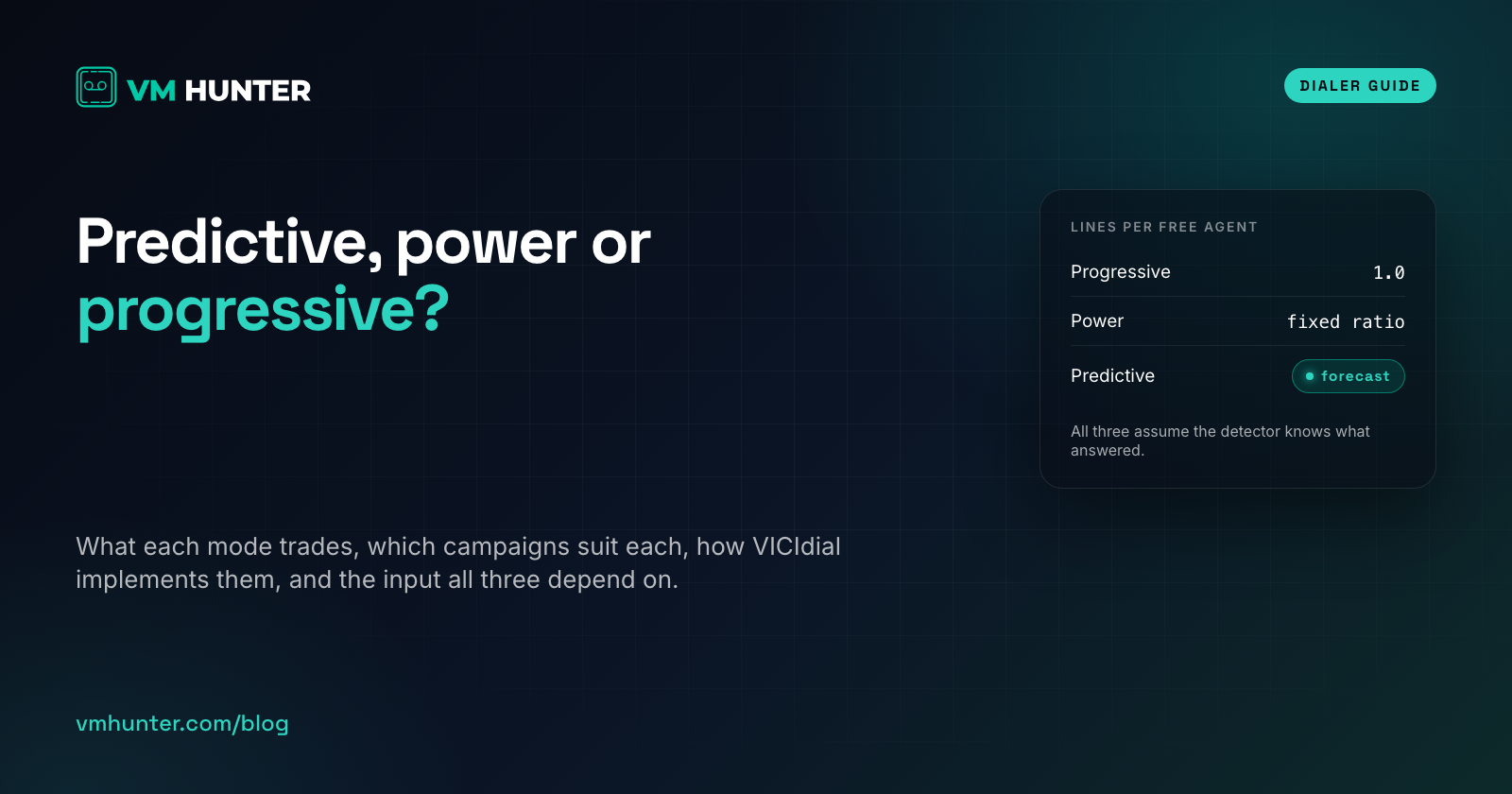
Every outbound dialer offers some version of the same three choices: progressive, power and predictive. They are usually presented as a ladder from cautious to aggressive, with predictive at the top as the mode serious floors graduate to. That framing hides the real decision, which is about what you are willing to trade. Each mode buys agent utilisation with a different currency: caller experience, compliance exposure or list quality.
This post explains what each mode does, where each one fits, how VICIdial implements them, and the one dependency they share that decides how well any of them works.
Progressive dialing: one call per agent, placed when the agent is free
Progressive dialing places a single call for an agent as soon as that agent becomes available. The agent sees the lead, the dialer dials, and the agent is on the line from the first ring. Nothing is dialled that an agent cannot take.
What you get. No abandoned calls, because every call has an agent attached before it is placed. Callers never hear silence. Agents see the record before the conversation starts, which matters in B2B, collections and anything where the first sentence depends on who you are calling.
What you pay. Agent time spent listening to ringing, busy signals, voicemails and dead numbers. On a consumer list where a third of calls are answered and half of those are not people, an agent may spend more time waiting than talking. Utilisation in progressive campaigns commonly sits around forty to fifty percent.
Best for. Small teams, high-value leads, B2B lists where the agent needs the account open before dialling, regulated verticals where any abandon is unacceptable, and warm follow-ups.
Power dialing: a fixed ratio of calls per agent
Power dialing places a fixed number of calls per available agent, typically between one and three, without predicting anything. If the ratio is 2.0 and five agents are free, ten calls go out. The first answered calls go to agents; any answered call with no agent free is dropped or handled by a message.
What you get. Higher utilisation than progressive, because the ratio absorbs the calls that fail. Simple to understand and to set: there is one number.
What you pay. A fixed ratio ignores how the list is behaving right now. When answer rates spike, for instance in the early evening on a consumer list, the dialer places the same number of calls and abandons more of them. When answer rates dip, agents wait. Power dialing drifts in and out of the abandon limit unless someone adjusts the ratio by hand.
Best for. Mid-sized floors with stable lists, campaigns where the answer rate does not swing much through the day, and teams that want more throughput than progressive without trusting an algorithm.
Predictive dialing: the algorithm sets the ratio
Predictive dialing places calls based on a running forecast of how many will reach a live person and how soon agents will free up. It watches answer rate, average talk time, average wrap time and the current abandon rate, and adjusts the number of lines per agent continuously. The goal is to have a live person arrive just as an agent becomes free, and no sooner.
What you get. The highest utilisation of the three, often seventy percent or more on a well-run consumer campaign. The dialer handles the time-of-day swings that power dialing cannot.
What you pay. Abandoned calls are a feature of the mode, not a failure. The forecast is probabilistic, so some live people will answer when nobody is free, and the dialer drops them. Regulators cap this at three percent of live answers, and the algorithm steers toward whatever target you give it, with the compliance consequences if the target is set too high. Predictive dialing also needs volume: below roughly ten agents the forecast is too noisy to be useful.
Best for. Larger floors on consumer lists, telemarketing and lead generation at scale, any campaign where talk time per agent-hour is the metric that matters and where the compliance team has signed off on a drop target.
How VICIdial exposes the three modes
In VICIdial the choice is the campaign's Dial Method.
- MANUAL is progressive in spirit: the agent initiates each call.
- RATIO is power dialing. Auto Dial Level is the fixed ratio.
- ADAPT_HARD_LIMIT, ADAPT_TAPERED and ADAPT_AVERAGE are the predictive methods. Each adjusts the dial level automatically toward the Adaptive Dropped Percent target, within Adaptive Maximum Level, with different back-off behaviour as the drop rate approaches the target.
Drop Call Seconds applies in RATIO and the ADAPT methods and should sit at two or lower to stay inside the two-second rule. Safe Harbor Audio plays to dropped callers. The dial level and drop rate interaction is covered in detail in its own post.
The input all three modes depend on
Every mode above assumes the dialer knows which answered calls reached a person. Progressive assumes the agent will hear it. Power and predictive assume the detector will decide it. In both cases the answering machine detector is doing the sorting, and its error rate feeds straight into the mode's weaknesses.
In progressive mode, a weak detector costs agent time. Every voicemail that reaches the agent is ten to fifteen seconds of listening and dispositioning. On a list where half of answered calls are machines, that is the difference between forty percent utilisation and fifty.
In power mode, a weak detector costs abandons in both directions. Machines marked as human reach agents and tie them up, so live people arrive to find nobody free. People marked as machines are dropped or played a recording, which is an abandon the dialer does not count.
In predictive mode, a weak detector corrupts the forecast. The algorithm models live-person arrivals from the detector's verdicts. If the verdicts are wrong on one call in five, the model is fitting noise, the dial level oscillates, and the admin ends up capping it far below what the list could support. The hidden abandons, live people disconnected as machines, do not appear in the drop statistics and surface only when someone listens to recordings.
Timing-based detection, which measures silence and greeting length, is wrong in a way that hurts every mode: it mistakes talkative people for greetings and short greetings for people. A speech-based detector that decides from what is actually said in the first two seconds, and returns a reason with each verdict, gives all three modes a cleaner input. The mode choice still matters. It just stops being the thing that limits throughput.
An illustration: moving up the ladder
This is an illustrative scenario, not a VM Hunter customer. A home-services lead-generation company ran a twelve-agent floor on VICIdial in RATIO mode at a dial level of 1.8. They had tried ADAPT_TAPERED twice and backed out both times because the dial level swung between 1.3 and 2.6 within a shift and the abandon rate hit three percent on the high swings.
Before a third attempt they audited the detector. A sample of a hundred HUMAN dispositions contained twenty-six voicemails and carrier messages. A sample of a hundred MACHINE dispositions contained seventeen live people. The forecast had been built on verdicts that were wrong on more than a fifth of calls.
They put a speech-based detector in front of the campaign for a week, left the dial method on RATIO, and resampled. False humans fell to three in a hundred, false machines to two. Then they switched to ADAPT_TAPERED with a one and a half percent drop target. The dial level climbed over two days and settled between 2.7 and 3.0 with the abandon rate at just over one percent. Talk time per agent-hour went from twenty-two minutes to thirty-one. The predictive mode had been fine all along. It had been predicting from bad data.
Choosing a mode: a short decision guide
Choose progressive when the lead is worth more than the agent's waiting time, when agents must see the record first, or when any abandon is unacceptable.
Choose power when you have a stable list and a mid-sized team, want more throughput than progressive, and are willing to adjust the ratio by hand through the day.
Choose predictive when you have at least ten agents on a campaign, a consumer list with a predictable answer pattern, a signed-off drop target, and a detector you have audited.
Whatever you choose, measure the detector first. Pull a hundred HUMAN and a hundred MACHINE dispositions, listen, and count the errors. If either direction is above five percent, no dial mode will perform the way its description promises.
FAQ
Is predictive dialing legal? Yes, within the abandon limits of the jurisdiction you dial into. In the US that means no more than three percent of live answers abandoned per campaign over thirty days, with a safe-harbor message played within two seconds on any abandoned call.
What is the difference between power and predictive dialing? Power uses a fixed number of lines per agent that you set. Predictive adjusts that number automatically from live statistics. Power is simpler; predictive is higher throughput and needs more agents to work.
How many agents do I need for predictive dialing? Around ten on a campaign as a practical minimum. Below that the forecast has too little data and the dial level swings.
Does answering machine detection work in progressive mode? Yes, and it is still worth having. In progressive mode the detector saves the agent from listening to the greeting; the call is dispositioned as a machine before the agent hears it.
Why does my adaptive dial level keep swinging? Most often because the detector feeding it is unreliable. Audit the verdicts before changing adaptive settings.
Can I run different modes on different campaigns? Yes. Dial Method is a campaign setting in VICIdial. Many floors run progressive on B2B and callbacks, and predictive on consumer lists.
The mode is a choice about what to trade. The detector decides how much you have to pay. If you want to see what your own campaign's verdicts look like before choosing, the free plan covers five thousand calls a month and the VICIdial client installs alongside the built-in detector in under an hour.